High School
Sgraffito Plates
Previous Learning Experiences/Prior Knowledge (What have students already learned before this project, what knowledge do they have about the subject?)
Previously students have used clay to build projects. They have an understanding of the slab roller, slipping and scoring, and glazing. Additionally, they have seen the various stages of clay such as raw/ wet clay, bisque fired and finished pieces. Students were told on Friday that this week they will be starting a portrait of someone who is influential in their lives. We used a website that the students are familiar with called Remind to have them send me their photos ahead of class. This way I was able to print their photos before class.
Developmental Characteristics What are the developmental characteristics of this age/grade level? Why is this specific lesson appropriate for this age/grade level? Please use professional education and art education references such as articles and books.
http://pioneer.netserv.chula.ac.th/~tampai1/ampai/Drawing%20Development%20in%20Children.htm
14-16 years old: The period of decision - “Art at this stage of life is something to be done or left alone. Natural development will cease unless a conscious decision is made to improve drawing skills. Students are critically aware of the immaturity of their drawing and are easily discouraged. Lowenfeld's solution is to enlarge their concept of adult art to include non-representational art and art occupations besides painting (architecture, interior design, handcrafts, etc.)”
Child Development and Arts Education: A review of Current Research and Best Practices
“Though motor and physical development has reached an adult maturity by around 16 or 17 years old, the connections between neurons affecting emotional, physical, and mental abilities are incomplete” (Strauch, 2003).
Inconsistent choices
“Unfortunately, those who do not meet societal ideals often internalize feelings of anxiety and guilt about their apparent lack of self-control” (Sparkes, 1997; Ruffin, 2009).
Developing a personal identity
Valuing social interactions
What’s the Enduring Understanding? What do you want the students to really understand from their art learning after they have forgotten the details of the project? Why is this topic worth studying?
Enduring understandings are statements summarizing important ideas and core processes that are central to a discipline and have lasting value beyond the classroom.
How to use symbolism to show importance in a portrait.
What’s the Significant Idea?
The Significant Idea is the key concept at the core of this learning opportunity, giving the student the opportunity to explore, extend, or acquire meaning from that Idea beyond busywork or decoration. The ability to shape an idea into a form of expression or effective sign that can be recalled and reconstituted for other uses is an act of learning. The Significant Idea being explored in this activity should be able to connect with previous learning or evolve into the premise for subsequent learning.
State the Significant Idea in the form of a single word (e.g., “Self-image.”)
Symbolism
Portraits
Positive and negative space
Essential Questions: Using essential questions to drive learning in classrooms from kindergarten to college is a smart way to dive deeper into higher-order thinking. Just as important, using essential questions can help students make key connections between what they are learning in the art room and apply it to their own lives and the greater world.)
Why do artists use symbolism?
How do artists utilize positive and negative space?
How does the technique being used relate to the message of a piece?
Learning Objectives:
A learning objective is a statement that describes what the student is intended to know or be able to do as a result of a lesson. The learning objective must be both fundamental and focused. A fundamental learning objective indicates that what a student is intended to learn is a building block for further learning. A focused learning objective is as specific as possible in sketching out the significance of what a student is intended to learn. Is the objective to aid the personal agency of the student? Is the objective to address a vital social issue? Or is this a skilled objective that will help build the competence of the learner in depicting significant ideas with some measure of excellence? State a fundamental and focused learning objective in the form of a single sentence (e.g., “Students will learn that self-image is malleable and can be reinterpreted through the construction of a series of installations exploring important influences at home, at school, and in our communities and their positive or negative effects on how we picture ourselves.”). You only need one single objective to generate a powerful lesson, but multiple objectives are sometimes appropriate.
Students will be able to incorporate the sgraffito technique into a clay project by designing a portrait.
Students will be able to create a portrait by selecting an influential individual of their choosing.
Students will be able to construct a plate by operating the slab roller.
Students will be able to illustrate the importance of their portrait through the use of symbolism.
Specific Linked Assessments: Include at least one of each listed below. (See assessment resources on Blackboard)
What outcome[s] might provide evidence that the learning objective has been reached successfully? Proposed outcomes can be multiple but must remain linked to the learning objective and anticipated benchmarks along the way.
Assessment helps teachers determine if the learning experience that students are engaging in needs improvement, as well as determines how/what students are learning. Authentic assessment usually includes a task for students to perform and a rubric/criteria by which their performance on the task will be evaluated. Assessments can be formative (in progress) and summative (final product). Assessment may also take the form of Pre-Assessments that assess prior knowledge in order to effectively plan for the entire group. Assessments should be directly aligned with the established learning
objectives for the lesson. Include notes on EACH of the following for EACH lesson plan.
-Pre-Assessment Checking for prior knowledge.
Powerpoint presentation
Opening activity
“What do you notice about these portraits? What are the artists trying to show? Discuss symbolism, color choice, facial expressions, words, etc.”
-Assessing student planning (Formative Assessments): Formative assessments that measure idea generation, refinement of plans, and choice-making in relation to making a product. These can take the form of checklists, sketchbooks, or planning sheets.
Using Remind to send me their influential person
-Assessing student products (Summative Assessments): Summative assessments that measure the application of skills, media, and art concepts in a product generated as a result of the lesson.
Walking around discussing the individual they chose and why they chose them
Have students explain the symbolism they’re using around around their portrait
-Assessing student reflections: Summative assessments that measure student understanding of personal message/meaning, understanding of the relationship with the artist or theme, the process, and media used, the technical skills that were gained. These can take the form of checklists, brief constructed responses, peer assessments, etc.
Artist statement once they complete their project
Key Artists & Artworks: Include information and Images
In the interest of being actively Anti-Racist and Inclusive, represent Black, Indigenous, People of Color (BIPOC), LGBTQ, Non-Binary & persons with diverse abilities in your lessons. Center your choices around artists that may be silenced or invisible, expanding the “canon” of which artists are worthy of study. Include a RANGE of artists, at least three for anyone lesson plan. Avoid lessons that have students create work “in the style of” a single artist. Look for contemporary artists.
Ana Trillo
Ayumi Horie
Tjimpuna Willams
Learning Object (A learning object is a concrete example of the Significant Idea students will explore, the on-ramp that directs classroom learners toward the general vicinity of the lesson objective. Serves as an attention-grabber, a lesson-starter, and a means for re-focusing on the task at hand. Can be animal, mineral, vegetable, famous, obscure, an activity, a demo of a particular technique, a film clip, a deep thought, pink and fluffy, etc.) Please list SPECIFIC learning objects used for this particular lesson!
Opening activity
Padlet
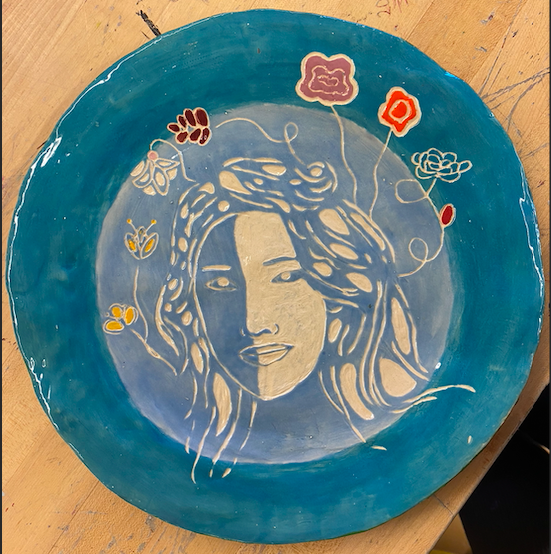
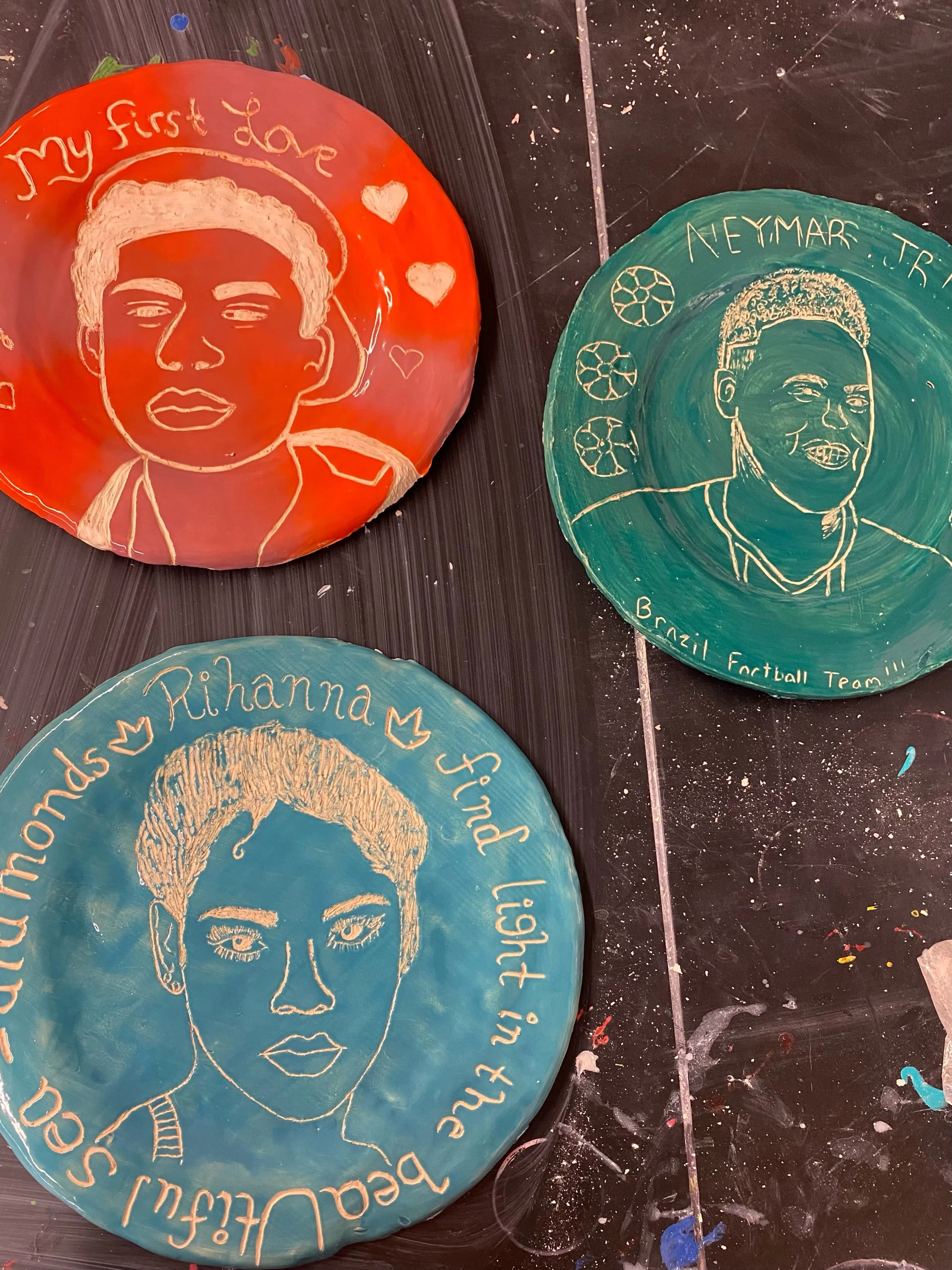
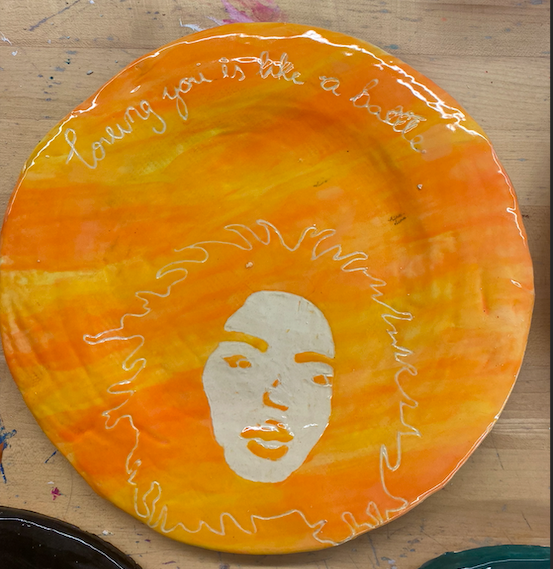
Two ceramic plates with sgraffito on them
Universal Design for Learning (UDL) Lesson Specific Plans:
UNIVERSAL DESIGN FOR LEARNING – How will you plan for the variety of abilities you will face in a diverse classroom?
Representation: What are the different ways you can present information to students? Be specific to your lesson.
Presenting a PowerPoint
Pictures
Video
Physical example
Engagement: What are the different ways you can engage students in the content you want them to learn? Be specific to your lesson.
Padlet
Group discussion
Expression: What are the different choices you will give students to express their learning?
Students decide who their portrait is of
Students design their own design around the portraits
Students can use trace paper or carve right into the plate depending on what they’re comfortable with
Activity Map: (What will the students do in class today and in what order? Use the learning objective as your target in constructing the activity for the day. Describe the sequence used in teaching this lesson. Mandatory: Please use the following format: Introduction, Demonstration, Studio Time, Process Assessment, Conclusion, Clean Up, and include approximate times for each step.)
Introduction - 5 minutes
Opening activity projected on the board
QR code for the padlet is on the computer ready for them to scan it when they walk in
Can answer the question from their table, class computer, or class Ipad
Demonstration - 10 minutes
Powerpoint
What sgraffito is
Artist examples
Video
Steps
Studio time - 29 minutes
Working on their designs
Print photos
Putting it on trace paper
Adding designs around it
Process assessment - happening during studio time
Walking around
Conclusion - happening during studio time
Announcing clean up
Clean up - 3 minutes
Clean up slide on the board
Content Standard connections: (Use National Core Arts Standards) Choose two or three MAIN standards. If you can connect Standards for other content areas for interdisciplinary lessons, etc, ALSO list those here.
NYS Art Standards
VA:Cr1.1.HSI - Use multiple artmaking approaches to begin creative endeavors.
VA:Cn10.1.HSIII - Synthesize knowledge of social, cultural, historical and personal life with artmaking approaches to create meaningful work of art or design.
VA:Cr2.2.HSII - Through experimentation, practice, and persistence, demonstrate acquisition of skills and knowledge in a chosen art form.
Vocabulary Including Age Appropriate Definitions:
See the websites:
http://www.seymour.k12.wi.us/faculty/rliart/vocab.cfm
Google other possibilities for art vocabulary! List words and definitions here:
Sgraffito - Carving in clay that has slip on it in order to expose the color of the clay
Positive and negative space - positive space is the subject of the work while negative space is the background and space around the subject
Slab - a flat piece of clay
Teaching & Student Materials/Equipment/To-Do List: (What consumable supplies need to be ordered and organized? What equipment needs to be prepared and tasks need to be completed before the learning encounter takes place? LIST EVERYTHING)
To-Do
Have trace paper ready
Some students have already sent in photos using school tools. If they have, those photos can be printed before class
Have light boxes set up
Materials
Trace paper
Pencils
Erasers
Printer
Phones/ computer/ Ipad
GUIDED DISCUSSION:
Topic Question – Notes Introducing the “hook.”
This introductory area of discussion provides the first “spark” or “hook” intended to capture each learner’s interest and inspire curiosity at the outset of the lesson. The Significant Idea is introduced through the Learning Object. Note down a logical sequence for your questions, followed in each case by the likely student responses in parentheses. Or, alternatively, you may choose to visually diagram or storyboard the set-up and opening sequence sequences of the learning encounter.
“Has anyone ever drawn a portrait before?”
Association Questions – Notes
Connecting student responses to the Topic question with the Significant Idea.
Depending on the array of responses to the topic question, the teacher guides the learner towards deeper associations to the topic idea that has been introduced, and toward contextualizing that Significant Idea within their own various experiences and interpretations. The Significant Idea is linked through guided conversation to individual student ideas.
“Who are three influential people in your life?”
“How could we use symbolism to show our portrait is of someone influential?”
Visualization Questions – Notes
Visualizing individual and diverging approaches to exploring the Significant Idea.
Now the focus of the dialogue is redirected towards exploring possibilities for showing, depicting, or representing the ideas that surfaced during the association segment of the lesson discussion; questions should now focus on a specific property, quality, or use of a material or particular process and organizing student ideas within the framework of the activity. Individual student ideas connect to individual artmaking possibilities and approaches.
“How could utilize positive and negative space using the sgrafitto technique?”
Transition Questions – Notes
Prompting students to consider the first steps in their chosen approach.
Now the focus of the dialogue is redirected towards helping the students get started on their work. After a full discussion, the student may have an array of ideas in mind and yet be unclear how to sort them and choose a direction, or uncertain what first steps to take. This crucial portion of the dialogue helps students to translate their thoughts into meaningful action with materials.
“How has your influential person effect your life personally? How can you show that?”
Student Choice:
In what way can you offer students opportunities for choice during this lesson? Can they choose the message of their work, the materials they will use? Can you vary the types of assessment you use or offer a choice of assessment? Give specifics.
Students decide who their portrait is of
Students design their own design around the portraits
Students can use trace paper or carve right into the plate depending on what they’re comfortable with
Lesson Extensions/Adjustments for Students:
My plan if a student works well and quickly. How will I challenge that student further?
Add more details
Start writing about who they chose and why
My plan if a student works slowly and most of the class is ready to move on:
Let them continue working on their sketch next time
Encouraging them to keep working
Letting them work during lunch or when they have study hall
My plan if I have students with varying abilities and need to use different techniques or materials, but will still be related to the lesson:
I have several students who do not enjoy touching the clay. For them I will help them roll out their slab and also provide them gloves.
Lightbox for tracing parts of their portraits will also be provided for students who are not comfortable witht their drawing skills.
Clean-Up Plan:
What procedures do I need to teach/demonstrate for this particular lesson so that tools and materials are put away efficiently and smoothly? How much time do I need to give for clean up for this lesson? What steps and procedures do students need to follow for a smooth clean-up? How will I communicate those steps visually and verbally? Bullet point and outline your specific plan for this lesson.
Having a clean up slife on the board
Announcing when it is time to clean up and what I expect of them
Since this is the first day introducing this lesson there should not be too much clean up
Display of Student Work:
What are the possibilities to display student work? Where can it be displayed? How can it be displayed? Who will create the display, teachers or students? Why? How can this display interrupt the norms of “typical museum display?” How can art appear in the school/community in a way that is accessible to all community members/the public?
I think a gallery walk style and have student go around and talk about their plates once they are finished would be successful.
Another fun idea could be to have students bring in food/snacks and we all eat off our plates. However, I realize this option is less doable.
Possible Substitute Teacher Plans for this project: (In the event of your absence)
If possible, leave work that a non-art educator can deliver to students that are related to whatever project you are working on.
“Students will be designing a portrait of an influential person in their lives. Most students sent in photos that they can grab them from the front table at the beginning of the class. If students did not send me a photo, have them use the computer to find a picture of an influential person in their lives that is from the shoulders up. They will be transferring these photos onto trace paper and then adding symbolic imagery and/or words around their portrait that relates to their chosen person. The light boxes are set up around the classroom to help students trace their portraits.”